

Porirua Schools Step Up on Climate
Opinion piece by Michele Whiting and Conor Twyford
Climate change can often feel overwhelming. The scale of the challenge is immense and the solutions can seem distant. But in Porirua, something quietly powerful is happening and our schools are helping lead the way.
Last year the city hosted the Porirua Assembly on Climate, bringing together mana whenua, community members and rangatahi to answer the question: Learning to live with Porirua’s changing world together: How do we connect and respond as our climate changes? The Assembly was a first for Aotearoa, and in many ways a first internationally, bringing together mana whenua, community members and young people in a Tiriti-based process to deliberate.
One of the most powerful contributions came from tamariki and rangatahi themselves.
Young people from schools across Porirua shared their concerns about the world they will inherit through poetry, waiata and art. When they presented their whakaaro to Assembly participants, many adults said it changed how they saw the challenge ahead.
But what came next may be even more important.
Instead of the Assembly recommendations sitting on a shelf, a small group of passionate educators across Porirua decided to pick up the challenge and formed an Education Workstream to explore how climate learning could become a living part of the local curriculum.
In late February this year that work took a major step forward.
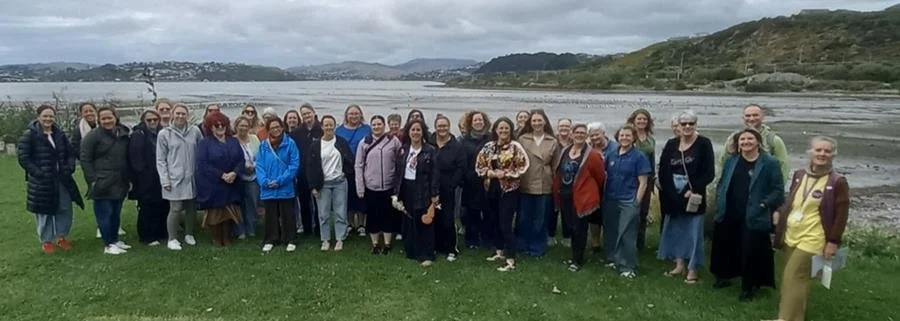
Forty-five teachers, including principals, primary kaiako, secondary educators and early childhood teachers, gathered at Pātaka to establish the Porirua Community of Practice on Climate Education. They came from twenty-five schools and ten kindergartens across the city.
That kind of turnout does not happen by accident. In the months leading up to the hui, organisers contacted every principal in Porirua to invite their schools to be part of implementing the Assembly’s climate recommendations. What followed was a day filled with conversation, reflection and shared commitment.
Kaiako heard the story of the Assembly and the role rangatahi played within it. They visited the Mutumutu ki Mukukai exhibition curated by Ngāti Toa Rangatira, which tells the story of land loss, environmental damage and the long journey to restore the harbour. They explored how local knowledge, mātauranga Māori and scientific understanding can work together in climate education.
Most importantly, they sat together as educators and asked a simple question: What are we already doing, and how can we build on it?
Across Porirua, students are already planting trees, restoring soil, exploring the science of climate systems, and learning about the history of their local environment. They are visiting the harbour, learning where their food once came from, and asking hard questions about how we care for our whenua and moana.
The difference now is that teachers are beginning to connect this work across schools.
Rather than isolated projects happening in individual classrooms, educators are forming a network to share ideas, resources and support. The seeds of a city-wide community of practice have been planted.
For kaiako, the motivation is clear. As one teacher reflected after the hui, the collaboration “brings such hope and innovation in tumultuous times.”
That hope matters, with schools today facing enormous pressure. Curriculum changes, resource constraints and competing priorities mean teachers are constantly asked to do more with less. Yet despite those pressures, Porirua’s educators are stepping forward because they recognise something fundamental: climate learning cannot be separated from the lives of the children they teach, it is their future, it is their now!
For many tamariki in Porirua, climate change is not the only issue they face. Housing and kai security, health challenges and economic pressures are often much closer to home. But connecting young people with Te Taiao, with our harbour - Te Awarua o Porirua, the whenua and their cultural identity, builds something deeper than knowledge.
It builds belonging. It builds agency.
When young people understand their place in the world, they begin to see that they have a role in shaping its future.
Climate action is often framed as something governments must solve. But lasting change also grows in the everyday places where communities learn and act together.
In Porirua, that work is already underway in our classrooms.
If you would like to tautoko this kaupapa — by sharing resources, contributing a koha toward our next hui, or offering your skills — please contact: porirua.assembly@ngatitoa.iwi.nz.