

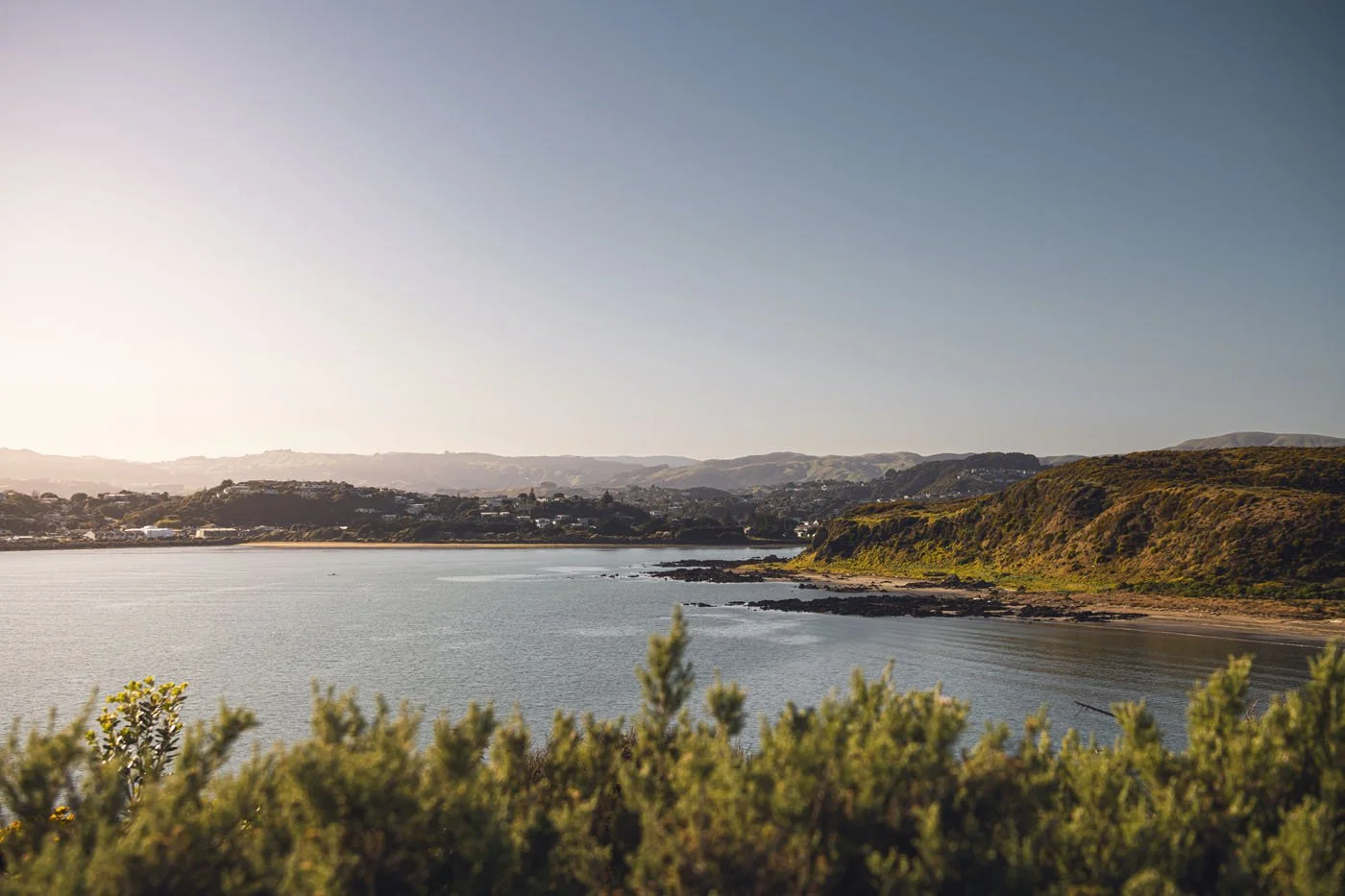
Rangatahi Resilience
Building the conditions to help Rangatahi navigate the roughest of waters.
-
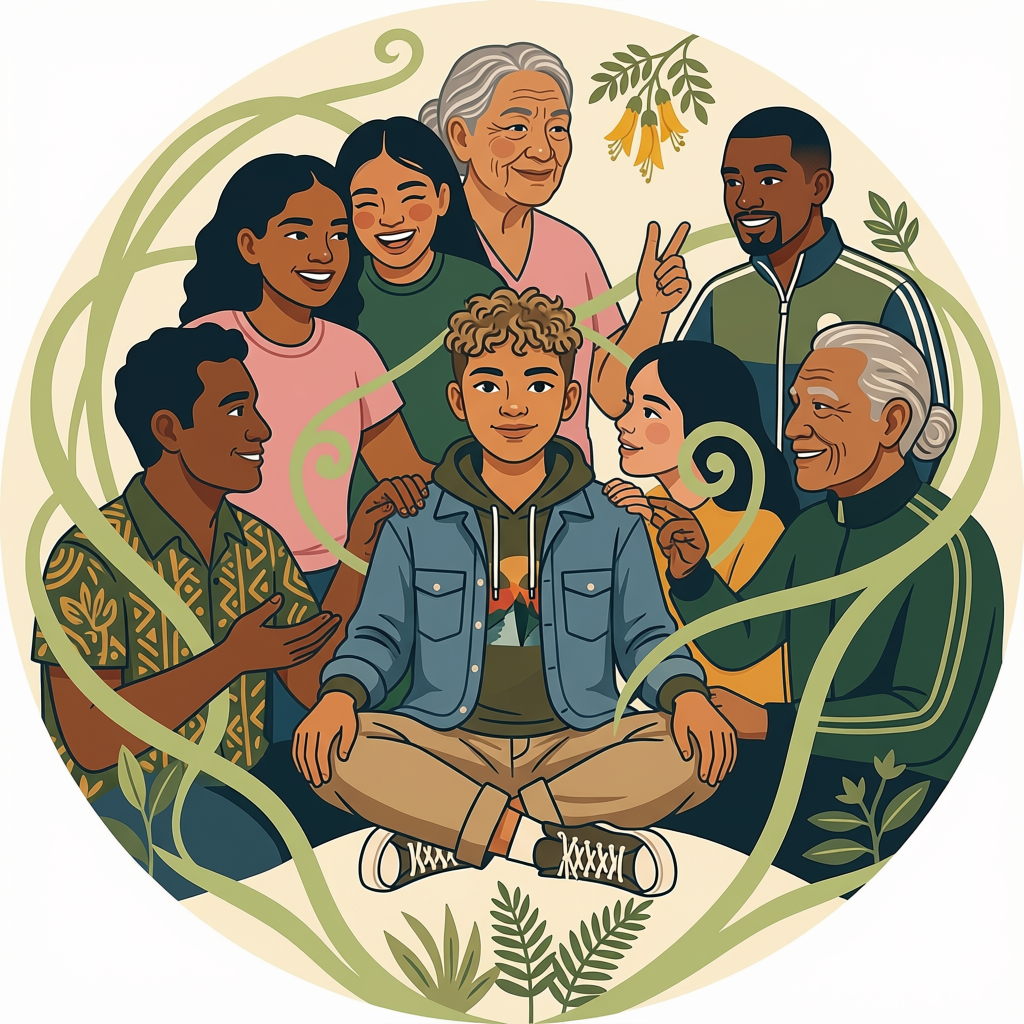
Rangatahi Resilience Kaupapa Group
The Rangatahi Resilience Kaupapa Group brings together providers, iwi, and community leaders to create the conditions that help rangatahi navigating the roughest waters not only stay afloat, but thrive.
If you care about improving Rangatahi resilience and want to be part of the solution, we’d love you to join us.
-
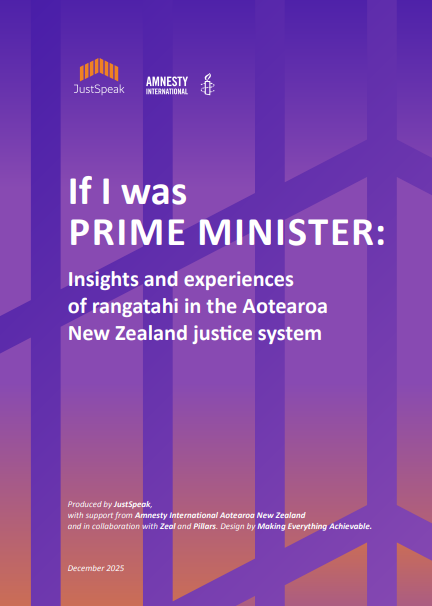
If I was Prime Minister
This report is the culmination of a two-year research project gathering stories and knowledge from rangatahi who know firsthand the challenges of the current justice system. These rangatahi, along with insights from people who support them, highlight what is needed to truly make a difference.
-
Mana Taiohi
Mana Taiohi is a principle-based framework that informs a way to work with young people in Aotearoa. These principles have helped to inform our approach.
Watch this video of Matt Renata from Ara Taiohi explain the framework, and how it centres on the mana of young people, and how we can whakamana (empower, encourage, and affirm) them through positive youth development.
Why Rangatahi Resilience Matters
Resilience shapes whether Rangatahi can navigate hard times and find what they need to thrive. Rangatahi don't build this alone. Resilience isn't about making them tougher as individuals. It's about making the communities around them safer, stronger, and accountable to what they need.
Positive early experiences can counter the effects of hard times that some young people face. This matters because experiences such as family harm or instability can influence health and wellbeing into adulthood and even across generations. The good news is that these outcomes are not fixed. Communities can help shape bright futures by creating the conditions that foster resilience, connection, and opportunity.
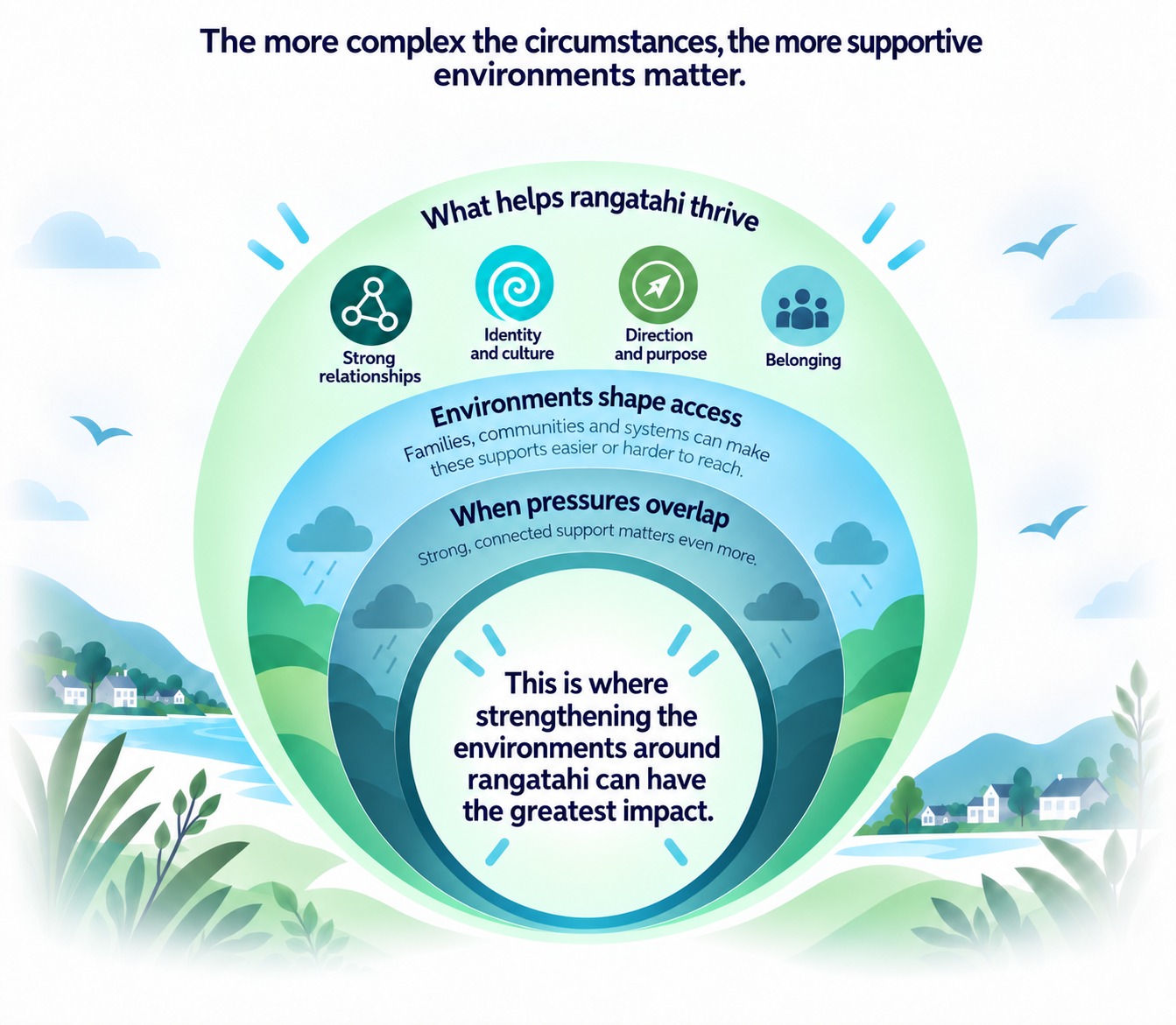
Alongside having secure access to basic needs like kai and housing, research points to several things that help Rangatahi thrive. Four of these align with the spirit of the Mana Taiohi youth development principles and serve as the starting point for this kaupapa:
Strong relationships: Having healthy relationships with whānau, friends, and mentors, and seeing healthy relationships modelled around them.
Powerful identities: Knowing and feeling pride in who they are and where they come from.
A sense of belonging: Feeling genuinely connected, safe, and valued within their communities and environments.
Direction and purpose: Having the support, opportunities, and confidence to shape their futures and play a meaningful, valued role in their community.
Small challenges might be weathered alone. But the more complex and overlapping the challenges, the more these conditions matter. That is why we're focusing on building them for Rangatahi navigating the roughest waters.
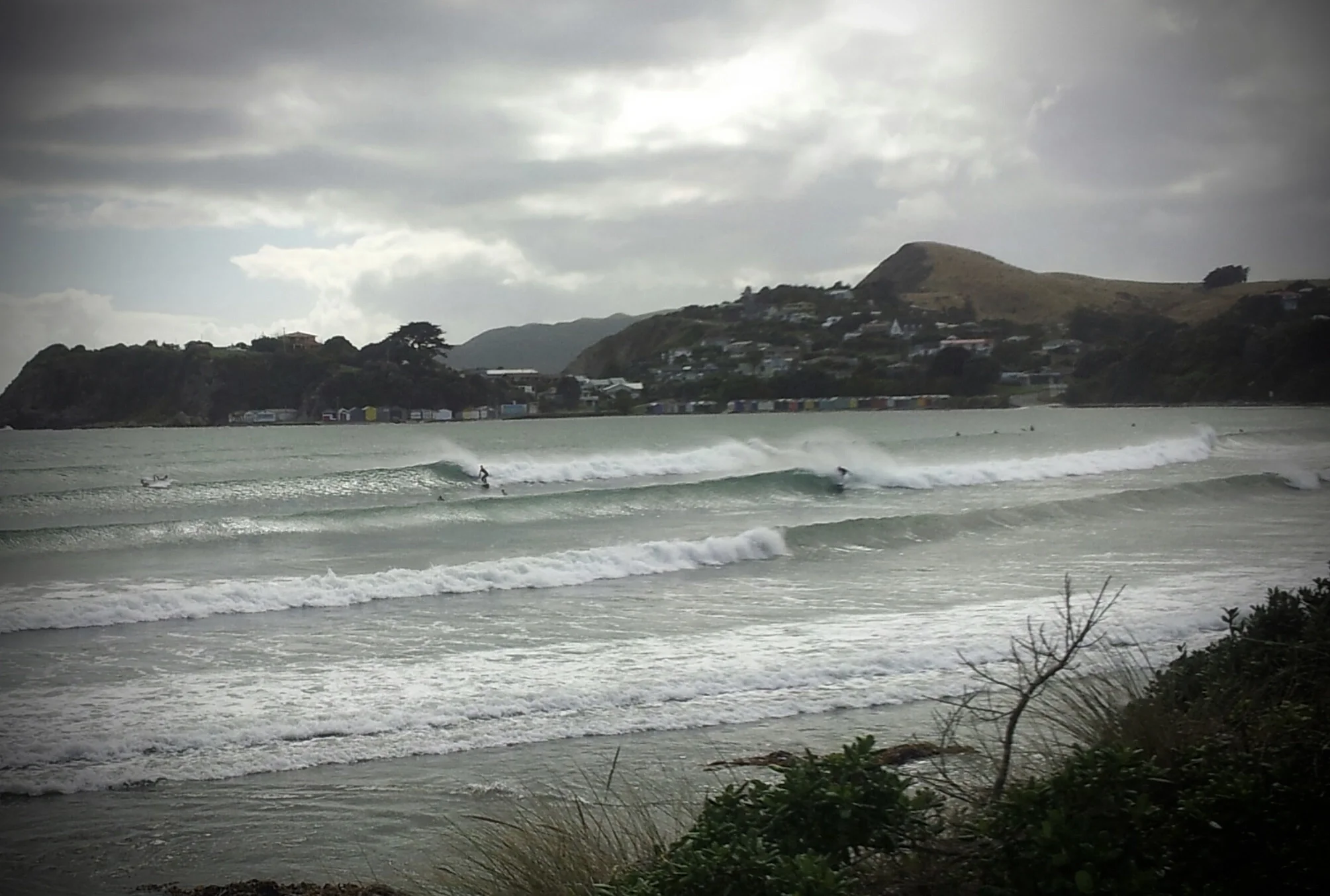
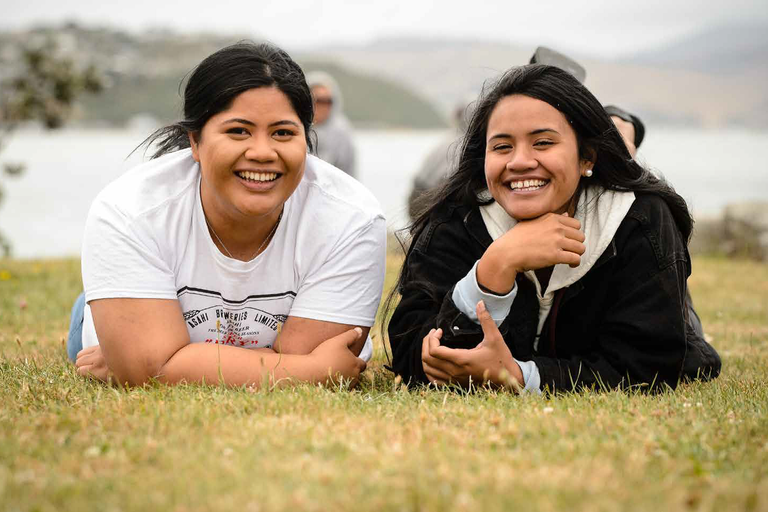
Learning to ride the waves is easier with a surfboard, a teacher, a wetsuit, and a safe place to fall.
Photo credit: David Adams
Evidence That Tells a Story
Rangatahi who encounter Aotearoa's justice system have had to navigate some of the most challenging circumstances of any young people. For some, offending is an act of necessity to survive. Just 10% of young people are responsible for more than three quarters of youth crime in Aotearoa. Most of these young people have had repeated referrals to multiple public service agencies, starting from a young age. Rangatahi Māori are overrepresented in these statistics.
Far from being an indicator of who these young people are, these statistics show that justice system contact is a marker of environments not providing what they need to thrive. In Aotearoa, these experiences are inseparable from the intergenerational legacy of colonisation, disconnection from whakapapa, and institutional discrimination.
This is where we can help turn the tide. The tougher a young person’s circumstances, the more that strong relationships, identity, agency, and belonging matter for helping them thrive. The following research reinforces this, showing that these conditions have the greatest impact for Rangatahi facing the most complex and overlapping challenges.
Findings from ‘If I was Prime Minister’
“As well as sharing the challenges they are facing, rangatahi shared what can make a positive difference. Several areas emerged as important to making a difference, including the power of relationships and belonging and the importance of positive and consistent interpersonal support.”
“I think ultimately it’s about giving young people something that matters, and I think having an influence like a mentor or someone to walk alongside life with you. What I’ve always tried to do and encourage my youth workers to do is just to let people know that their lives matter; just let people know that there’s value there.” – Youth Worker
“School for me wasn’t easy that’s for sure. I have learning disabilities so it was hard. Nobody thought I wanted to learn but they couldn’t actually help me they couldn’t cater to the way I learn. Almost got kicked out four times. But I had two teachers who had backs fully and believed in myself too. I ended up excelling after that...”
“Have my babies grow up in a healthy safe loving environment seeing them thrive”
Findings from ‘Wellbeing of children and young people who offend’
"“Most of the factors we observed as highly correlated to youth offending do not relate to any inherent characteristic of the individual young people... Rather, they reflect the characteristics of the environments in which they are being raised."
Findings from ‘Journeys of Resilience’
While Māori participants shared many of the same resilience strategies as non-Māori, the way this is conceptualised and enacted can be different for whānau. Five interrelated themes emerged from the interviews: whanaugatanga (whakapapa/kin group relationships that can extend beyond kinship groups); manaakitanga (caring for and hospitality to others); kotahitanga (unity, togetherness, solidarity); wairuatanga (spirituality); and rangatiratanga (self-determination).
While understanding of, and access to, Te Ao Māori varied among Māori research participants, Māori culture and identity in general was considered by all participants to be a positive and enriching experience and a significant factor in terms of its contribution to their overall wellbeing.
“In college the one thing that was really keeping me to be in college was kapa haka. I did kapa haka for three years in college. That bond that I had with my group really kept me in and kept me on the straight. They encouraged me to keep going and keep the Māori aspect which was really good. I loved having that. I want that for my daughter…” (Māori, female, 20-29 years)
“Home wasn’t a happy place. No-one gets to see our potential when we leave school early”
“A dream for young tamariki. Should be pushing to their limit until they get where they want to be”
“ In order to get through the hard we have to take a look into our lives & identify what cycles we need to break..”
“Our whānau need to know that they can be, do, anything they want”
“At home was hard. I was whāngai to my grandparents at 7 months. My biological mum took me up to Tūrangi and didn’t tell nobody, we were found I got taken back to Paekakariki and didn’t see my mum as much anymore. Real dad was never around”
What We Are Doing
We are focusing on building the environments and networks that give Rangatahi navigating the roughest waters access to the resources they need to thrive. We are starting with:
Strong relationships
Powerful identities
A sense of belonging
Direction and purpose
By bringing together individuals and organisations working across the community with Rangatahi, as well as those with lived experience, we support shared learning and more effective collective responses to their needs.
Our Approach: Kaupapa Groups through the Porirua Community Leaders’ Forum
Porirua Community Leaders’ Forum (PCLF) exists to foster relationships, strengthen local connections, and create a shared space for community-led action and learning. It brings together Porirua’s diverse leaders across iwi, community, Pacific, migrant, business, education, and social sectors to identify shared priorities and coordinate collective impact for our city.
As part of this model, kaupapa groups are established to move ideas into tangible action. Each group focuses on a specific area of community priority such as kai, housing etc.
The Rangatahi Resilience Kaupapa Group is a collective space to tackle barriers to access and shape practical solutions for our whānau focused on building the conditions to help Rangatahi thrive, despite adversity.
If you would like to be part of the solution, we’d love you to join us.
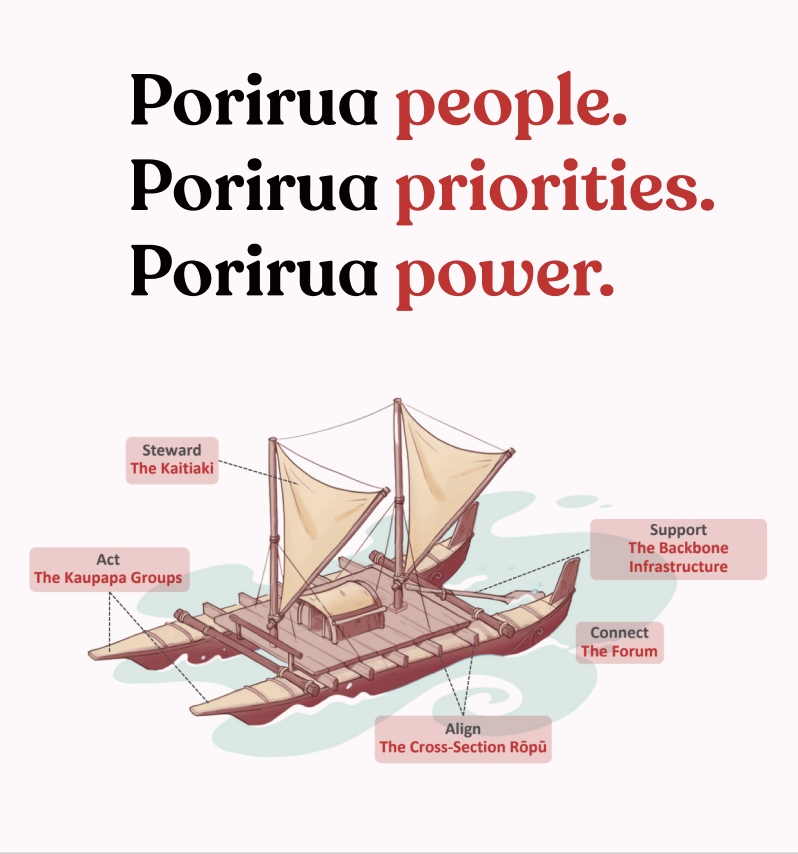
Read more about the Porirua Community Leaders’ Forum in the PCLF Operating Model.
Porirua moves forward because people like you step in. We need skills, time, and resources to keep the momentum going.
How Can You Help

Volunteers for workshops
Help facilitate conversations and keep sessions running smoothly.

Catering and kai
Sponsor food and drink for our next gathering.

Communications support
Design, write, or help spread the word about what we are doing.